There are very few policy wins these days but the scrapping of the two-child limit is a really important one. The scrapping of this cruel policy by the Chancellor Rachel Reeves in the Autumn 2025 Budget has been the result of many years of campaigning by the women’s sector, the Community & Voluntary sector and beyond who saw its impacts on children and families and on rising child poverty levels.
The two-child limit was introduced by the Conservative Government as part of a package of welfare reform changes in an attempt to cut spending. The policy prevented tax credit and benefits claimants from receiving an additional amount (child element) within these payments for any third and subsequent children born after 5 April 2017 which most recently has meant the loss of over £3,500 per child per year.
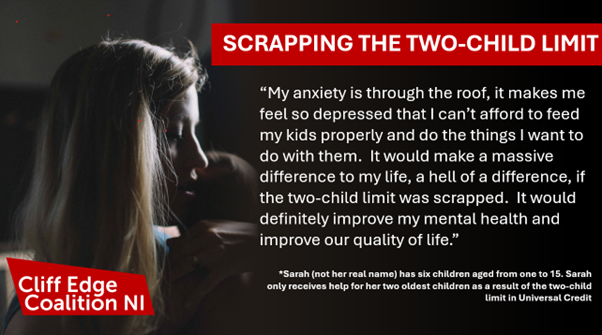
The policy intent for the two-child limit was that people on benefits “should face the same financial choices about having children as those supporting themselves solely through work.” However, research shows that almost 60% of the children affected by the two-child limit live in households that contain at least one working parent. Figures also show that the policy has had a minimal impact on birth rates but instead increased child poverty levels causing financial hardship and distress.
In Northern Ireland the two-child limit has a disproportionate impact because family sizes are bigger – 21.4% of families in Northern Ireland have three or more children compared to 14.7% in the UK. Figures show that one in ten children in Northern Ireland live in households impacted by the two-child limit. Of the 13,810 households impacted over 48,300 children were living in these households with 17,410 of those children not eligible for payments as a result of the two-child limit. We know that the two-child limit does not only impact on the third and subsequent children but on all the children in the household as well as their parents who struggle to manage financially on reduced amounts of benefits.
Aside from the costs to the children and families affected by the policy the wider costs of child poverty are significant. The Northern Ireland Audit Office have reported that the annual cost of child poverty in Northern Ireland is between £825million and £1billion per year. The scrapping of the two-child limit is therefore vital in helping to address Northern Ireland’s shocking child poverty figures where one in four of our children are living in poverty.
In scrapping the two-child limit, Rachel Reeves stated: “I believe every child has equal worth and deserves an equal chance to achieve their promise. The biggest barrier to equal opportunity is child poverty. Because for every child that grows up in poverty, our society pays a triple cost. The first and the heaviest is to the child……and there is also the cost of supporting a family in poverty which ends up in the lap of overstretched councils……then there is the future cost to our economy and to our society, of wasted talent and a welfare system that bears the cost of failure for decades to come.”
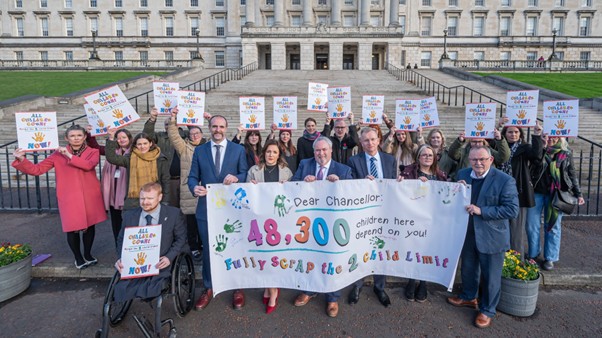
Campaigners from across the Community & Voluntary Sector at Stormont in November 2025 calling for the scrapping of the two-child limit ahead of the Autumn Budget
The women’s sector has long campaigned for the ending of the two-child limit and the associated rape clause which allowed for an exemption to the policy if parents could prove the child was conceived as a result of rape or an abusive relationship. When the policy was introduced the Women’s Policy Group wrote a paper opposing the two-child limit and the rape clause outlining the key equality and human rights impacts of the implementation of these measures.
Many women’s sector organisations are also members of the Cliff Edge Coalition which is a coalition of over 100 organisations who came together to sustain and strengthen crucial welfare reform mitigations including lobbying to end the two-child limit. The Coalition is driven by a common goal to address poverty levels in Northern Ireland and advocate for a stronger social security system to protect the most vulnerable. One of the Coalition’s key strengthening asks was the removal of the two-child limit and significant lobbying work was carried out by the coalition over a number of years and in the run up to the Autumn 2025 Budget to push for the scrapping of the policy.
The two-child limit is closely linked to another welfare reform policy called the Benefit Cap and both policies cause multiple and overlapping harms to children particularly in larger families. The Benefit Cap limits the total amount of social security benefits a household can receive. A mitigation payment is currently in place for the Benefit Cap in Northern Ireland until 31st March 2028. The scrapping of the two-child limit will make more people subject to the Benefit Cap and therefore entitled to this mitigation payment. It is vitally important that this mitigation payment continues so that families can enjoy the full benefits of the scrapping of the two-child limit. The Cliff Edge Coalition continue to campaign for the extension of the Benefit Cap mitigation in Northern Ireland beyond March 2028.
The removal of the two-child limit is due to take effect in April 2026 and the Cliff Edge Coalition are seeking assurance that legislation to secure this change in Northern Ireland will be progressed in the same timeframe. The scrapping of this policy will make a massive difference to the children and families who are impacted by it enabling them to better afford essentials such as food and heating and will undoubtedly help to address rising child poverty levels as well as putting extra money into local economies.
As a sector we are delighted to see the end of this heinous policy which disproportionately impacts on women causing them significant financial and emotional distress. We believe that removing this policy is an investment in children helping to improve their educational outcomes and life opportunities. The future depends on investing in all our children not just some.

